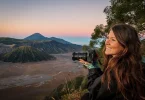
The best camera is the one you have with you, and on a trip that is your phone — a device whose computational tricks now outshoot the bulky cameras of a decade ago, provided the person holding it supplies the two things software cannot: position and patience. Learning how to take better travel photos with your phone is mostly learning to see like a photographer while carrying almost nothing: chase the light, simplify the frame, and save the filters for last.
Light First: the Golden Hours Do the Heavy Lifting
Photography is light with a subject attached, and travel light is best at the day’s edges. The hour after sunrise and before sunset — soft, warm, sideways — flatters everything from faces to facades and empties the famous places of their crowds as a bonus. Midday sun is the enemy you will often be handed anyway: mitigate by moving subjects into open shade (even light, no squinting), turning harsh scenes into graphic ones (shadows, silhouettes, saturated colour against white walls), or going indoors to museums and markets where light is mixed but interesting. Overcast days are portrait weather and street-photography gifts — the sky becomes a giant softbox. Plan the day’s photography around this, as this site’s travel photography camera settings guide insists for dedicated cameras: the phone obeys the same sun. One discipline transforms results overnight: before any shot, look at where the light is coming from and put it behind YOU or beside the subject — never let a bright window or sky sit behind a face you care about.
Composition: Fewer Things, Placed Deliberately
Most weak photos fail by inclusion: too much scene, nothing decided. Turn on the grid and use the rule of thirds as a starting grammar — subject off-centre, horizon on a line, not through the middle of heads. Then simplify ruthlessly: step closer (zoom with your feet; digital zoom is a crop in disguise), drop the stray bins and half-strangers at the frame’s edges, and choose ONE subject per photo — the doorway, the vendor, the mountain — letting everything else support or leave. Look for the photographer’s free gifts: leading lines (streets, rivers, fences converging), frames within frames (arches, windows, doorways), repetition and pattern (market stalls, tiles, umbrellas) and the human element that gives scale and story — a lone figure in the vast square says more than the empty square. Shoot vertically for social formats and faces, horizontally for landscapes and groups, and ALWAYS take the second frame from a different height — crouched and overhead versions routinely beat the eye-level original you almost kept.
Technique: Clean Lens, Steady Hands, Honest Modes
The single highest-yield maintenance act in phone photography takes two seconds: wipe the lens. Pocket lint and sunscreen film on that tiny glass cause more soft, hazy “my phone camera is getting worse” photos than any aging sensor. Then stabilise: elbows in, lean on the wall, hold your breath on the shutter tap, and use the volume button or a two-second timer to avoid the jab that blurs night shots. Learn the modes as tools, not defaults: Portrait mode’s background blur flatters people and food but hallucinates around hair and glasses — check its edges; Night mode is superb on a steady hand and tragic on a moving subject; the ultra-wide lens dramatises architecture and interiors but bends edges and shrinks distant subjects; the 2x or 3x telephoto is the portrait and detail lens and the correct answer to “too far away” more often than the wide. Focus and exposure are a tap away: tap the subject to focus, slide to darken a bright scene slightly — phone photos almost always improve a touch underexposed, because highlights, once blown, never return.
People, Permission and the Story Frame
Travel photography’s ethics are simple and improve the work: ask before close portraits (a smile and a gesture suffice across language barriers, and the resulting expression beats the stolen one), respect the no-photo signs and sacred spaces absolutely, and offer to send the picture — an exchange that has started a thousand good conversations. For story, shoot the trilogy: the wide establishing scene, the medium interaction, the telling detail (hands, tools, signage, the meal mid-steam). One honest detail outweighs five postcard angles. Keep the phone’s presence light in fragile moments — ceremonies, grief, poverty are not content — and remember the traveller’s version of our companion article’s budget discipline in how to find cheap flights: constraints, respected intelligently, are what separate craft from clutter. A photographer who shoots less, deliberately, comes home with more.
Edit Lightly, Archive Ruthlessly
Editing is salt, not sauce. The phone’s built-in editor handles the honest adjustments: straighten the horizon (the classic silent flaw), crop to the composition you meant, lift shadows slightly, warm or cool the white balance towards how the place FELT, and stop before skin turns plastic and skies turn apocalyptic. Apply a consistent light touch across a trip’s photos and the album acquires a look. Then be an editor in the second sense: review each evening, delete the duplicates and failures while the day’s memory can still judge them, favourite the keepers, and let a cloud backup run overnight — the trip’s photos are the trip’s second copy, and losing a phone should cost hardware, not memories. Master light, simplicity, a clean lens and a light edit, and the device already in your pocket becomes the travel camera you stopped needing to upgrade. That is how to take better travel photos with your phone: not more equipment — more intention per frame.